
Can You Grow Food Under Solar Panels?
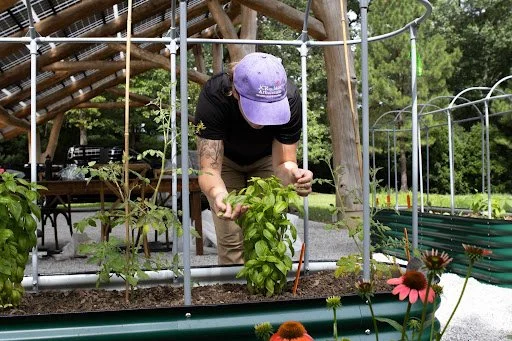
Photo: Andrew Huggins / UNC Gillings.
This summer, Burkett Farm conducted a small agrivoltaics demonstration site to understand how vegetables respond to growing beneath solar panels during North Carolina’s hottest months. Agrivoltaics, the practice of co-locating agricultural activities (such as crop production, livestock grazing, or pollinator habitats) with photovoltaic energy production, is growing in popularity as a dual-use strategy for agricultural land.
In this project, we wanted to evaluate whether small-scale agrivoltaics – growing food crops in raised containers under an existing structure with a semi-transparent PV array – was a viable resilience strategy for community organizations working toward food and energy sovereignty. Our hope was that the shade from energy-producing panels could create a cooler, steadier microclimate for plants during the hottest part of the summer, while still providing enough light for photosynthesis and overall plant growth. By planting identical crops in six raised beds, three under the array and three in full sun, we were able to watch, day by day, how heat, light, and rainfall shaped growth.
The project was managed by Libby Meier, a farmer‑turned‑public health student with a background in certified organic agriculture and environmental science. After years working in greenhouses and field production, she enrolled in UNC Chapel Hill’s Gillings School of Global Public Health, and joined the Burkett Farm team this summer as part of her practicum.
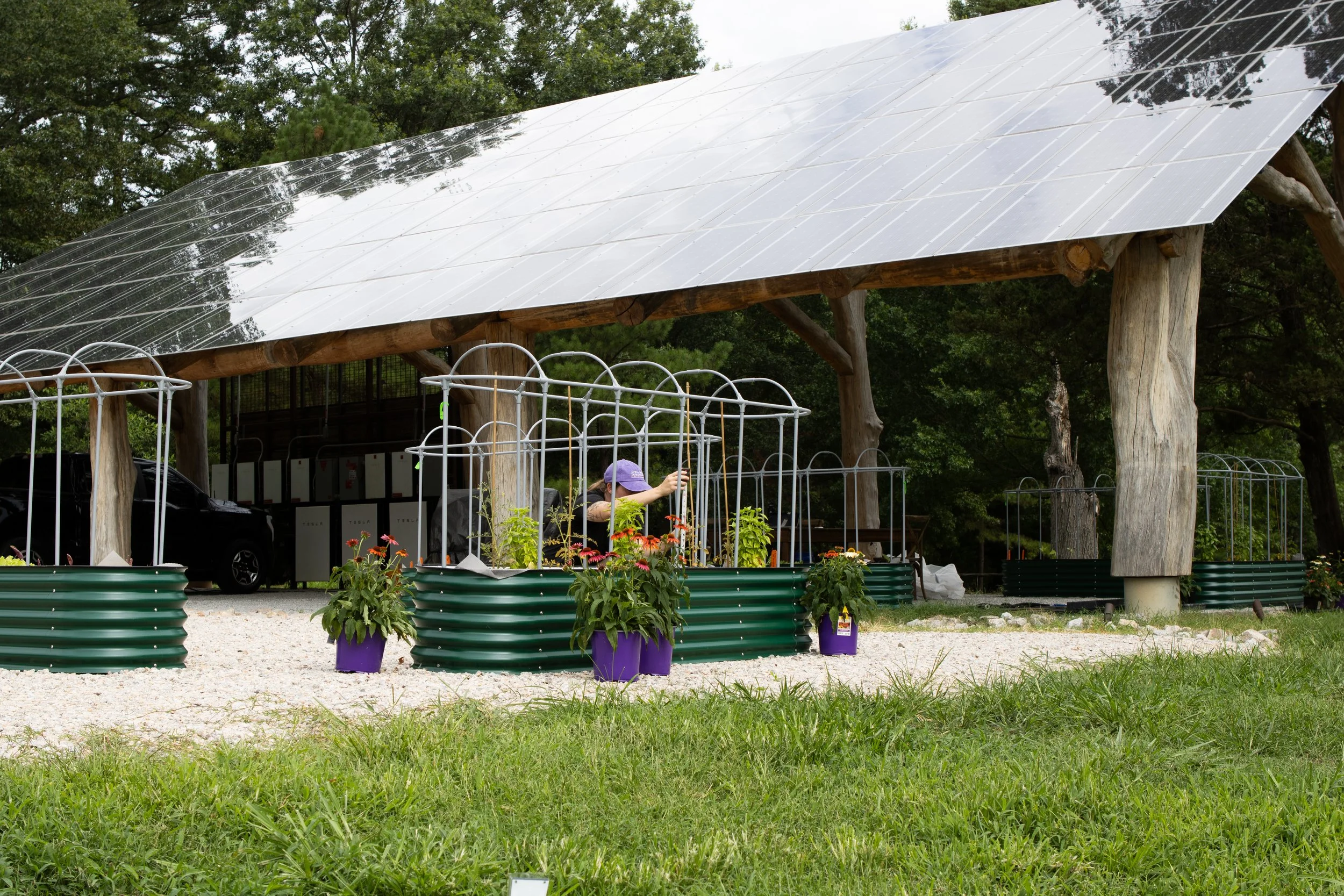
Photo: Andrew Huggins / UNC Gillings.
The results were surprising. On the whole, the crops growing under PV performed better than the crops in direct sun. Shade from the array consistently softened extreme conditions, providing cooler midday temperatures, slower water evaporation after irrigation, and steadier growth in greens, basil, and bush beans. Not all crops were a success, however: cherry tomatoes and radishes under PV both struggled to reach maturity.
We were particularly impressed by the performance of lettuce under PV. In summer months, lettuce grown in direct sun struggles with sun scald and turns bitter in flavor due to heat. On the contrary, the lettuce in the beds under the PV array thrived, growing to maturity in the seven-week trial.
But it became clear that microclimate was not the only factor in crop performance. The soil we chose to fill the containers was not right for the context; it compacted quickly in the containers, limiting aeration, and had low levels of macro‑ and micronutrients. That meant soil quality, not shade, was likely the main constraint. Even so, the moderated microclimate under the panels seemed to delay nutrient stress and limit compaction, giving shaded crops a little more resilience in tough soil conditions.
These observations shaped our recommendations for Enfield Energy Futures, a non-profit in the town of Enfield, NC, about one hour northeast of Raleigh. The organization is in the process of developing a Weatherization Lab, which will feature renewable energy infrastructure and offer education and resources for the town’s residents to lower their energy burden. As part of this plan, they’re interested in building a community garden on the site, with solar panel arrays suspended over the crops.
Matching crops to microclimate will support the production of fresh produce, cooking classes, and a welcoming community space. Agrivoltaics offers a simple but powerful benefit: solar panels can generate clean energy while creating a cooler growing environment that supports fresh, nutritious food. This is a meaningful opportunity in a town where cost, transportation, and limited grocery options influence daily food access.
Meanwhile, our summer study has ended, but our agrivoltaics demonstration site will live on. Taking the lessons learned from the summer, we’ll be making adjustments to the layout and soil medium in the containers, and then will plant out a new set of crops to study for the fall.
Interested in learning more about agrivoltaics? Check out these resources.
“North Carolina training site pairs sheep grazing with solar.” (Canary Media)
“How Agrivoltaics Can Help Solve Virginia’s Energy Crisis” (Piedmont Environmental Council)